



What is this Act all about?
Section 32 of the Constitution deals with the right of access to information and provides that everyone has the right of access to any information held by the State, and any information that is held by another person and that is required for the exercise or protection of any rights.
The Promotion of Access to Information Act 2000 gives effect to section 32 of the new Constitution subject to justifiable limitations, including but not limited to, limitations aimed at the reasonable protection of privacy, commercial confidentiality and effective, efficient and good governance and in a manner which balances the right of access to information with any other rights including the rights in the Bill of Rights in Chapter 2 of the Constitution.
The Act establishes voluntary and mandatory mechanisms or procedures to give effect to that right in a manner which enables persons to obtain access to records of public and private bodies as swiftly, inexpensively and effortlessly as reasonable possible.
The Act also promotes transparency, accountability and effective governance of all public and private bodies by empowering and educating everyone to understand their rights in terms of the Act, to understand the functions and operation of public bodies and to effectively scrutinise, and participate in, decision-making by public bodies that affects their rights.
Sections 10, 14, 16 and 51 came into effect on 15 February 2002.
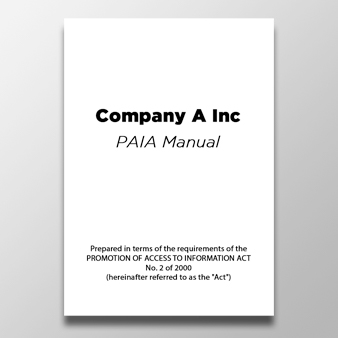
In terms of the Act all businesses must produce and file a Manual in order to comply with the provisions of Section 51 of the Act. This section requires every business to compile a Manual, to have it available for inspection and to file a copy with the South African Human Rights Commission.
The initial deadline for this was given as 28 February 2003.
Originally, there was a further requirement that each private body submit a copy of their manual to the Government Printer. Someone somewhere did some arithmetic and worked out that if every business actually filed a copy of their manual with the Government Printer, it would take years for the manuals to be printed – and that would be working at full output twenty four hours a day every day. This requirement was dropped.
Then, at the last minute the initial deadline for compiling the manual was extended to 31st August 2005.
On 31st August 2005 a further hastily worded last minute extension was granted by Brigitte Sylvia Mabandla the Minister of Justice. A copy of the Government Notice can be viewed here.
A statement from the Department of Justice that seeks to justify this extension reads: “This exemption should largely exempt the informal business such as street vendors, barbershop owners, some “spaza” shop owners, food vendors, shoemakers, etc.”
Informal businesses indeed! Read on.
In terms of this Notice, an exemption is granted, inter alia, to all private bodies, except any company not being a private company as contemplated in section 20 of the Companies Act, 1973 and being a private company as contemplated in section 20 of the Companies Act, 1973 which operate within any of the sectors mentioned in Column one of the Schedule to the Notice and has fifty or more employees in their employment or has a total annual turnover that is equal to or more than the applicable amount mentioned in Column 2 of the Schedule to the Notice.
The Notice goes on to say that exemption is granted “for a period of five years from 1 January 2006 to 31 December 2011.”
The period 1 January 2006 to 31 December 2011 is six years.
The exemption is stated to have been granted in terms of section 51(4) of the Promotion of Access to Information Act, 2000 (Act No. 2 of 2000).
This section provides that “For security, administrative or financial reasons, the Minister may, on request or of his or her own accord, by notice in the Gazette, exempt any private body or category of private bodies from any provision of this section for such period as the Minister thinks fit.”
It would be interesting to speculate on the nature of the “security, administrative or financial reason” that justifies the exemption for all private bodies – other than certain private companies and all public companies. For example, what “security, administrative or financial reason” was considered necessary to compel a private company in the Agricultural sector with a turnover in excess of R2 million or more than fifty employees to compile and publish a manual - but not a partnership, or a close corporation or a business trust with a similar profile? For that matter why should a sole proprietor who falls into this category be exempt but not a private company?
Why are companies being discriminated against?
And finally, most small to medium enterprises in South Africa fall within the range of private bodies that have been exempted. It is not just the “informal business such as street vendors, barbershop owners, some “spaza” shop owners, food vendors, shoemakers, etc.” that have been exempted – but practically every small to medium business in the country.
Is this what the Act originally contemplated? We think not.
If you would like to know more about the provisions of the Act, we have extracted those Sections of the Act that we regard as significant for the purposes of creating the Manual, including relevant definitions. You can view these here.
This website is intended as an aid to those private bodies that are required to produce and publish such a manual – and to those who may now be exempt but who wish to achieve a small measure of peace of mind. |